
Dental Implants
Straumann dental implants offer permanent tooth replacement with high clinical success rates--the closest restoration to natural teeth.
The Gold Standard in Tooth Replacement
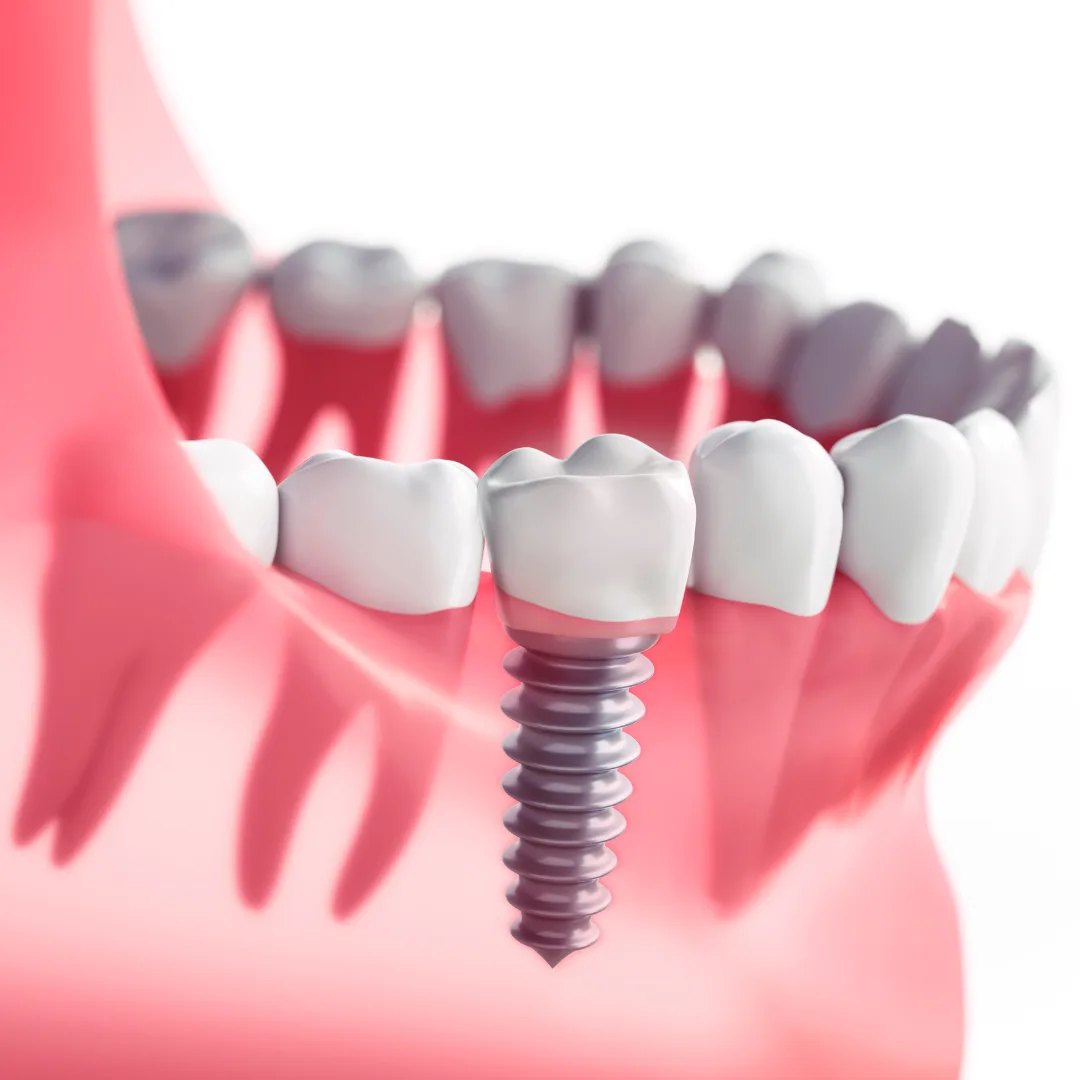
A dental implant is a permanent, surgically placed solution for one or more missing teeth. Unlike bridges or dentures that rest on your gums or depend on adjacent teeth, an implant anchors directly into your jawbone, functioning exactly like a natural tooth root. This fundamental difference makes implants the most durable, most comfortable, and most functional tooth replacement available.
At Thrive Dental, we use Straumann dental implants, one of the most widely studied implant systems with high clinical success rates supported by peer-reviewed research. Straumann’s advanced SLA surface technology promotes faster bone integration, often enabling placement of your crown in as little as 3 months.
The Implant Process: From Consultation to Restored Smile
Step 1: Comprehensive Evaluation (Appointment 1) We examine your mouth and take a CBCT (cone beam CT) scan—a 3D X-ray that shows bone quantity, density, and quality in precise detail. We measure the space needed for your implant, assess adjacent teeth, and evaluate your overall health. We discuss timeline, cost, and financing options. If you have bone loss from missing teeth, we determine whether bone grafting is needed before implant placement.
Step 2: Surgical Placement (Implant Day) Using local anesthesia, we create a small opening in your gums and precisely drill into the jawbone to the correct depth. We insert the Straumann titanium implant and close the gums. The entire procedure typically takes 30-45 minutes. You leave with stitches and clear post-operative instructions. Expect mild soreness, swelling (peaks day 2-3), and mild discomfort managed easily with pain medication.
Step 3: Osseointegration (3-6 months) This is the magic: your bone cells grow directly onto the implant surface, fusing it permanently in place. You can’t see this happening, but it’s essential. During this time, you can eat soft foods normally (no chewing directly on the implant site). Straumann’s SLA surface accelerates this process—many patients achieve full integration in 3 months.
Step 4: Abutment Placement (Minor Procedure) Once osseointegration is complete, we verify it with imaging. We then place an abutment—a small connector post that protrudes above the gum. This is a brief procedure under local anesthesia. Your gums heal around the abutment for 1-2 weeks.
Step 5: Crown Fabrication & Placement We take a precise impression of your abutment and have our lab craft a custom crown that matches your natural teeth perfectly in shade, shape, and translucency. At delivery, we verify fit, adjust bite alignment, cement the crown, and you leave with a fully restored tooth. Total timeline: 4-6 months (faster with Straumann and ideal bone).
Why Straumann Implants Deliver Strong Long-Term Results
Clinical Science: Straumann implants have been studied for 30+ years with published data showing 95%+ survival at 10 years. Dentists and patients choose Straumann because the science proves it works.
SLA Surface Technology: The implant post is treated with a sandblasted, acid-etched surface that creates microscopic texture. This promotes faster bone cell attachment and integration compared to smoother implant surfaces. Faster integration means faster treatment and faster confidence in stability.
Pure Titanium: Straumann uses medical-grade titanium (Grade 4 or Grade 5), proven biocompatible and unlikely to trigger allergic reactions.
Precision Engineering: Every component—abutment, screw, crown interface—is engineered to micron tolerances, ensuring long-term seal integrity and preventing biological complications.
Who Is an Ideal Implant Candidate?
Excellent candidates:
- Missing one or more teeth
- Ages 18+ (jawbone fully developed)
- Adequate jawbone density and height
- Good oral hygiene habits
- Non-smokers or willing to quit during healing
- No uncontrolled systemic disease
Possible candidates requiring additional steps:
- Bone loss from missing teeth for years: we perform bone grafting first
- Severe bone loss: we may recommend All-on-4 instead of multiple single implants
- Diabetes, bisphosphonate therapy, or other medical conditions: we coordinate with your physicians
Contraindications are rare: Even if you’ve been told you’re “not a candidate” elsewhere, we can often find a solution through bone grafting, All-on-4, or modified treatment planning.
Implant Longevity and Lifetime Care
Straumann implants are designed to be permanent. Proper care includes:
- Excellent oral hygiene: Brush twice daily, floss daily around the implant, and use an implant-specific water flosser
- Regular check-ups: We monitor your implant at every visit, checking for bone loss or signs of infection
- Avoid smoking: Smoking reduces blood flow and accelerates bone loss around implants
- Protect from trauma: Avoid chewing on hard objects (ice, hard candy, pens); if you grind your teeth, wear a night guard
- Professional cleaning: Annual or biannual cleanings keep the implant site disease-free
Studies show implants lasting 30-40 years or longer with this level of care. The crown on top may need replacement after 15-20 years due to normal wear, but the implant itself is expected to last a lifetime.
Single Implant vs. Bridge vs. Implant-Supported Bridge
Single Implant:
- Strongest candidate: one missing tooth in good bone
- Preserves adjacent teeth (no crown prep needed)
- Highest cost upfront, lowest lifetime cost
- Easiest to floss and maintain
- Most durable, most natural-feeling
Bridge:
- Candidate: one missing tooth, but adjacent teeth need crowning anyway
- Requires less bone
- Lower upfront cost
- Requires tooth modification (crown prep) on two adjacent teeth
- Lasts 10-15 years vs. 40+ years for implants
- Harder to floss under
Implant-Supported Bridge:
- Candidate: multiple missing teeth in a row
- Uses implants as anchor teeth instead of natural teeth
- Combines advantages of implants and bridges
- More stable than traditional bridge
Implant Placement for Multiple Missing Teeth
If you’re missing several teeth, you have options:
- Multiple individual implants: One implant per missing tooth (requires more bone, takes longer)
- Implant-supported bridge: Two implants supporting crowns for 3-4 teeth (more efficient)
- All-on-4: Four tilted implants supporting a full arch (see our All-on-4 page for details)
We’ll evaluate your bone structure and recommend the most efficient option.
Cost and Financing
A single Straumann implant, abutment, and crown investment varies depending on complexity and materials. We accept Cherry, CareCredit, and Sunbit financing to spread costs over 6-12+ months with low or 0% APR options (subject to eligibility). Explore our flexible financing options to make your implant treatment affordable. Many dental insurance plans cover a percentage of implant costs; we’ll verify your benefits and manage claims. Contact us for a personalized cost estimate.
Why Choose Thrive Dental for Your Implant
We place Straumann implants across our five Northern California locations. Our doctors focus on implant placement and restoration. We use CBCT imaging for surgical precision. We work with trusted laboratory partners for crown quality. Most importantly, we stand behind our work with comprehensive aftercare and support.
Ready to restore your missing tooth permanently? Schedule a no-pressure implant consultation today. We’ll evaluate your candidacy, discuss options, and answer all your questions.
Explore Other Restoration Options
If dental implants aren’t ideal for your situation, consider All-on-4 implants for full-mouth restoration, crowns and bridges, or dentures. For underlying gum health concerns, explore gum disease treatment. Visit any of our five Northern California locations or schedule your appointment today.
Frequently Asked Questions
A dental implant is a titanium post surgically placed into your jawbone to serve as an artificial tooth root. After 3-6 months, your bone fuses to the implant (osseointegration). We then attach an abutment and custom crown on top. The result feels, functions, and appears like a natural tooth. Straumann implants use advanced SLA surface technology that accelerates bone integration.
Straumann is one of the most widely studied implant systems with high clinical success rates supported by peer-reviewed research over 10+ years. They use pure titanium with SLA (sandblasted, acid-etched) surface technology that promotes faster, more reliable bone integration. Straumann implants integrate in as little as 3 months. We choose Straumann because the science supports superior long-term outcomes. Individual results may vary.
Most people are candidates if you have adequate jawbone density and overall good health. We evaluate you with a CBCT scan (3D X-ray) to measure bone quantity and quality. Non-candidates might have bone loss from missing teeth for years; in those cases, bone grafting can build up the bone first. We also consider medical conditions and medications that might affect healing.
Initial consultation and CBCT imaging. Surgical placement (Day 1): 30-45 minutes under local anesthesia. Osseointegration: 3-6 months while bone fuses to implant (you wear nothing or a temporary). Abutment placement: minor procedure. Crown fabrication and placement: 1-2 weeks. Total time: 4-6 months. Straumann implants often allow 3-month timelines in ideal bone.
No. You're fully numb with local anesthesia. Most patients feel pressure and vibration but not pain. After surgery, expect mild to moderate soreness for 3-5 days, managed with prescribed or over-the-counter pain relief. Swelling peaks at 2-3 days then resolves. Most patients are surprised how tolerable recovery is.
Straumann implants are designed for a lifetime. Published studies report implant survival rates above 95% at 10 years, among the highest of any dental restoration. The crown on top may eventually need replacement (15-20 years), but the implant itself is permanent with proper care and maintenance.
A single implant typically costs more upfront than a bridge or partial denture. However, implants last 30-40 years or longer; bridges last 10-15. When you factor lifetime cost and the superior function/comfort of implants, they're often more economical. We work with Cherry, CareCredit, and Sunbit to make implants affordable.
Yes. Implants are the closest restoration to natural teeth. They feel firm, don't move, don't require special care, and function like real teeth. You won't be aware it's there. Unlike dentures, implants don't cover your palate, don't need adhesive, and don't require removal for cleaning.
This is a key advantage of implants. When you lose a tooth, the jawbone underneath starts to shrink within weeks (resorption) because there's no root stimulating the bone. Over years, significant bone loss causes facial collapse and premature aging. Implants prevent this by stimulating bone just like a natural tooth root.
Most health conditions don't prevent implants. We'll review your medical history, current medications, and any concerns. Poorly controlled diabetes may affect healing. Certain bone-loss medications (bisphosphonates) need discussion with your physician. We work with your doctors to ensure safety.
Related Services
All-on-4 Implants
Replace an entire arch with just four implants. All-on-4 offers permanent teeth in one day with significant functional advantages over dentures.
Dental Crowns and Bridges
Precision-engineered crowns and bridges that restore damaged teeth and close gaps--durable restorations lasting 10-15+ years.
Get Dental Implants Near You
Ready for Dental Implants?
Schedule your appointment at any of our five Northern California locations. Our team is here to help you achieve the smile you deserve.